HDR Corona 2026
Taken by Lorenzo Comolli on August 12, 2026 @
Villahoz, Spain
Click photo for larger image

| |
Camera Used: Unavailable Unavailable
Exposure Time: Unavailable
Aperture: Unavailable
ISO: Unavailable
Date Taken: 2026:09:19 15:06:02
|
|
| More images
Details:
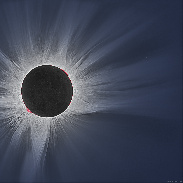
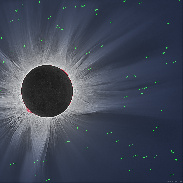
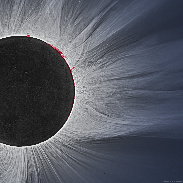
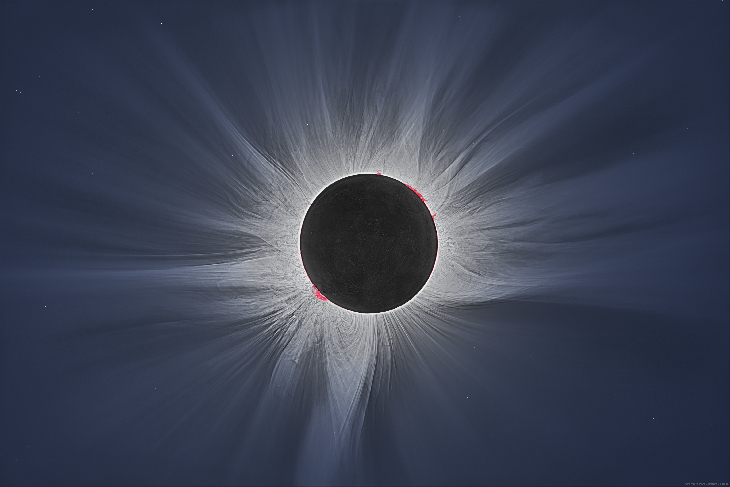
The HDR corona from the TEC140+ASI6200MM setup. A great amount of fine detail is visible all along the corona. Prominences from C2 and C3 contacts were added in red. The Moon's edge appears oval due to the 1.5 min duration of this eclipse, as the Moon moved during acquisition. Many tens of stars are visible, with the brightest being SAO 98574, mag. 6.8, at 42' from the Sun's center. Lunar craters craters and maria are also visible thanks to Earthshine.
This is the main setup of my eclipse expedition and it was not easy to pack the scope, mount and all accessories in my car, together with my family (2 adults + 2 kids) and everything needed for the holiday.
The camera is an ASI6200MM, a full frame of 61 Mpix 16 bit monochrome, and it was my second time using an astronomical camera instead of a reflex camera on a total eclipse (the first being in USA 2024). This was possible thanks to the big improvement in download speeds of modern astronomical cameras, e.g. this big frame sensor downloads to the PC in less than half a second!
TEC140 apochromatic refractor plus APM-Riccardi 0.75x reducer (dia 140 mm, FL 740 mm, f/5.3), ASI 6200 MM camera (CMOS full frame 62 Mpix, 16 bit monochromatic, binning 1, 3.76 um/pixel, cooling at +10°C), Scorpio-Astro SA-17 mount, Luminance filter, exposures between 2 ms and 480 ms at 1.32 EV stops at gain 0 (equivalent to 215 ISO, EV stops from 12.7 to 4.7), 171 frames stacked from an effective exposure of 24.4 s captured during 82 s of total duration. Image capture via an automated sequence in SharpCap recording data at ~2 fps with a data flux of 242 MB/s into a SER file.
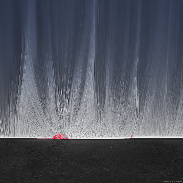
Image processing by Lorenzo Comolli using Siril for preprocessing with dark, flat and darkflat calibration frames, alignment on SAO 98574 (barely visible on the 2 ms exposures group), HDR composition using a custom-made MATLAB script designed to extract the proper part of corona from each exposure group, processing in Photoshop using High Pass and Radial Blur filters as explained in my 2018 tutorial (see end of this page).
Photographer's website:
https://comolli.astrosurf.com/ecl26a.htm
|
|
|